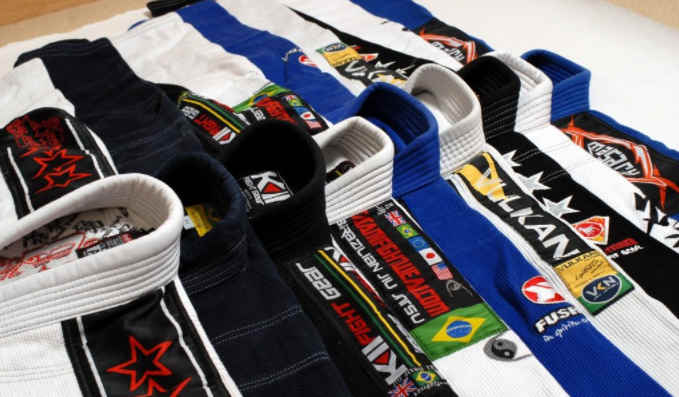
Pick your gi by fabric weight first. A 300 GSM pearl weave keeps you cool and helps on weigh-in day, 450 GSM is the all-round standard for daily training and competition, and 550 GSM is the heavyweight that outlasts years of hard grips. Everything else, colour, cut and patches, follows from that choice and from whether you plan to compete under IBJJF rules.
What does GSM mean on a BJJ gi?
GSM is grams per square metre, the weight of the jacket fabric. Higher GSM means a denser, tougher, warmer jacket that is harder for an opponent to grip through. Lower GSM means a lighter, cooler gi that dries faster and costs you less on the scale. Most of what people call gi "quality" is really this trade-off between durability and weight.
Which gi weight should you train in?
Use this as a starting point, then adjust for your climate and how often you roll.
| Weight | Best for | Trade-off | AUN gi |
|---|---|---|---|
| 300 GSM ultra light | Hot gyms, weight cuts, twice-a-day training | Wears out faster under heavy grip fighting | Ultra Light BJJ Gi |
| 450 GSM pearl weave | Daily training and competition, the default choice | None significant, this is the balanced option | Competition, IBJJF Legal, All-Around, Blackout |
| 550 GSM heavyweight | Hard grip-heavy rolling, cold gyms, long service life | Hot to train in and slow to dry | Heavyweight, Premium |
Is a lightweight gi legal for IBJJF competition?
Yes. The IBJJF does not set a minimum fabric weight. It regulates colour (white, royal blue or black, and the whole gi must match), cut and sleeve length measured with the arm extended, collar thickness, and where patches may sit. A 300 GSM gi passes the measurement check as readily as a 550 GSM one, which is why competitors on a weight cut favour it.
The exception is colour. A black and gold gi like the Premium is a showcase kit, not a competition gi.
What is pearl weave, and why is it the standard?
Pearl weave is a jacket weave with a small raised bead pattern. It became the BJJ standard because it holds up to grip fighting at a lower weight than the older gold or single weaves. Gi trousers are usually ripstop instead, a reinforced grid weave that cuts weight where you do not need grip resistance.
How do you pick the right gi size?
BJJ sizing runs A0 to A6 for adults, with F and C ranges for women's and children's cuts. Size by height first, then weight. If you fall between two sizes, size down when the gi is pre-shrunk and size up when it is not, because an unshrunk cotton gi can lose most of a size in the first few hot washes.
- Measure your height and weight, and check them against the size chart on the product page.
- Confirm whether the gi is pre-shrunk. AUN gis are, so the size you buy is the size you keep.
- Check sleeve and trouser length with your arm and leg extended, which is how a referee checks them.
- If you compete, leave room at the wrist and ankle so the gi still passes after a wash.
How should you wash a BJJ gi?
Wash cold and hang dry. Heat is what shrinks a cotton gi and breaks down the stitching at the collar and the knees. Wash after every session, because the bacteria that cause skin infections live in damp fabric, not on the mat alone. Do not bleach a coloured gi and do not tumble dry on high, whatever the care label on a cheaper gi tells you.
Which AUN gi fits your training?
All of these are pearl weave, pre-shrunk, and cut for the federation where a federation applies.
- Competing this season: Men's or Women's Competition BJJ Gi, 450 GSM, cut to clear the IBJJF measurement check.
- Training most days: All-Around BJJ Gi, 450 GSM, the everyday workhorse.
- Training in heat, or cutting weight: Ultra Light BJJ Gi, 300 GSM.
- Want one gi to last years: Heavyweight BJJ Gi, 550 GSM.
- Buying for a club: any of the above in volume, with your logo and colours.
AUN Sports manufactures in Sialkot, Pakistan and ships worldwide. Request a wholesale quote for club and team orders, or browse the full BJJ gi range.